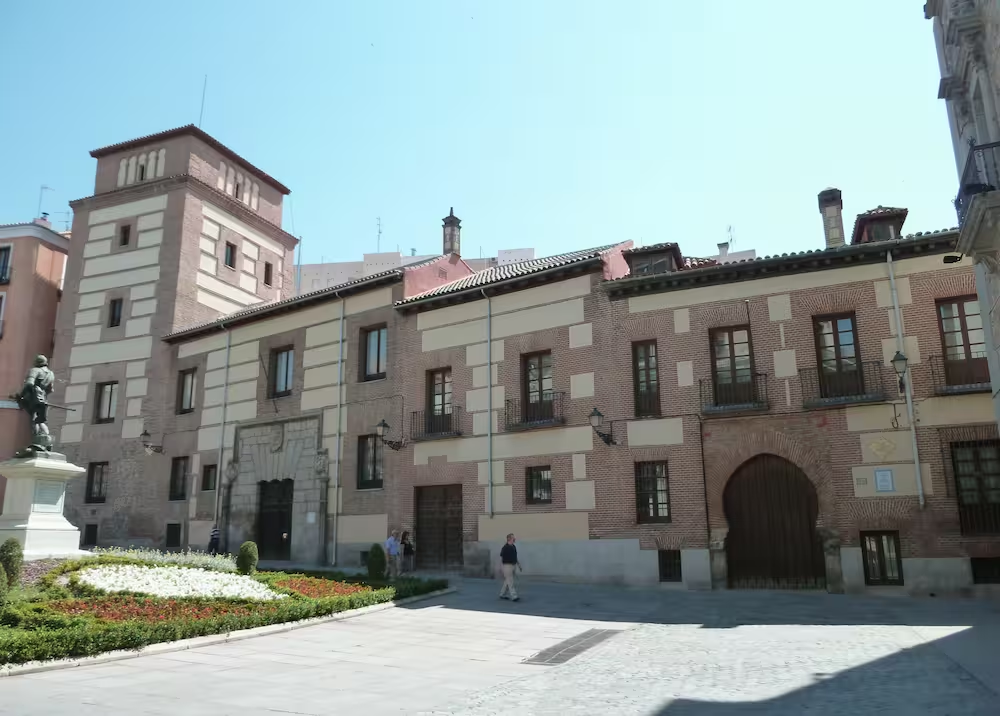
The houses and tower of the Lujanes, located in the ancient Plaza de San Salvador—today known as Plaza de la Villa—are the main hallmark of Madrid’s civil architecture from the medieval era, as this complex constitutes the only 15th-century palace-house preserved in Madrid.
The Houses of the Ocaña Family
In the northern half of its plot (approximately today’s number 2 of the square), the ancient houses of the Ocaña lineage stood at the beginning of that century, complete with wine cellars and a bakery oven. They bordered the houses of the heirs of Diego Díaz and those of Pedro de Vargas: their owner was Gonzalo García de Ocaña, Chief Accountant and Clerk of the Chamber to King John II. In 1442, Gonzalo received 187,664 maravedís from Pedro Briones, the royal chamberlain, to pay Pedro de Luján, who was also a chamberlain to the king.
Years passed, and in the second half of 1449, Gonzalo passed away without having settled the debt. Consequently, on January 20, 1450, the Royal Council ordered the execution of the debt by seizing and publicly auctioning Gonzalo’s assets.
Blanca García, Gonzalo’s widow, then appealed to the so-called “privilege of widows and orphans,” requesting that the ordinary mayor of Madrid oversee the case; among other arguments, she claimed that half of those houses belonged to her, as they had been acquired during her marriage to the accountant.
Her petition did not succeed, and it was ultimately Juan Mosquera, Royal Bailiff and executing judge, who took charge of the process. The auction began on February 25; Fernando, the town council’s crier, announced it three times in the Plaza de San Salvador so that both the residents of the town and those of the outskirts (*arrabal*) would be properly informed.
Following an initial bid of 100,000 maravedís, two men representing Pedro de Luján entered the bidding: Juan Vázquez de Ávila and Diego Hernández Maderuelo, who raised the offer to 181,000 maravedís, the final amount for which the auction was closed.
The Luján family took effective possession of the houses on April 27, represented by their attorney Juan Vázquez. Blanca García, Gonzalo’s widow, and their children, moved to the parish (*colación*) of Santa María, though no record remains of their exact location.
The Majorat of San Salvador

In this manner, on April 27, 1450, the houses of the Ocaña family passed into the hands of the chamberlain Pedro de Luján. From that moment on, he would turn them into the primary residence of the San Salvador branch of the Luján lineage, one of the most powerful in Madrid.
In 1449, the master of the table (*maestresala*) Juan de Luján, Pedro’s elder brother, passed away. He lived in the family houses of San Andrés, built by their father Miguel Jiménez de Luján; these were adjacent to the church and would eventually become the palace of the Counts of Paredes, and nowadays, the Museum of the Origins (*Museo de los Orígenes*).

Starting in 1450, Pedro de Luján would begin the renovation and expansion of the new San Salvador houses, including the construction of the famous fortified tower. Pedro de Luján executed his will on December 31, 1472, establishing a majorat (*mayorazgo*) in favor of his firstborn son, Juan de Luján, “the Good.”
It is practically certain that Juan de Luján continued to reside in his houses of San Andrés, as it is documented that he dwelt there when he died, and that in 1518 his widow, María de Luzón, still inhabited them. His 1499 will confirms the construction of the tower at the San Salvador houses and states that the southern half of the plot already belonged to his brother Álvaro de Luján.
[caption id="attachment_2851" align="aligncenter" width="300"]
Both on the houses of the Plaza de la Villa and in the courtyard of the Museum of the Origins, the coat of arms that identified the lineage can still be seen today: four quarters corresponding to the Luján lineage and a border featuring fourteen castles over bridges, characteristic of the Aponte lineage.
DOCUMENTATION
- 1450: Seizure and auction of the houses and properties of Gonzalo García de Ocaña; includes his will dated April 11, 1449. General Administration Archive (AGA), box No. 8115.
- 1472, December 31: Will of Pedro de Luján. AGA, sign. 8115.
- 1499, December 21: Will of Juan de Luján, “the Good.” Royal Academy of History, M-62, fº106-110v.
- 1518: Map of the houses of Pedro Laso and María de Luzón in Madrid, next to the city wall and the Puerta de Moros. General Archive of Simancas, MPD, 12,219.