Who invented karaoke? The story, as it’s always been told, begins in Japan in the 1970s —except that’s not quite how it happened. It really began fifty years earlier, in Madrid. Before you raise an eyebrow, though, let’s back up: not everyone agrees on what karaoke actually is.
The Real Academia Española —Spain’s own dictionary authority, for readers unfamiliar with it— defines karaoke, and I quote directly, as “entertainment consisting of singing along to a recorded musical backing track, while following the lyrics displayed on a screen.” The word itself is Japanese, from kara (’empty’) and oke (from ōkesutora, ‘orchestra’) —something like “empty orchestra.”
The invention of karaoke is usually credited to Japan, where it became wildly popular in the 1980s, and by now everyone knows the story. Some of you reading this have probably tried your own hand at it, or suffered a neighbour whose devotion to home karaoke machines shows little regard for the rest of the building. What you probably don’t know is that Madrid had already invented the thing, back in the 1920s.
“Hold on,” I hear you say, “are you telling me karaoke existed in 1920s Madrid?”
“I am telling you exactly that.”
“Well, I never…”
And so it was, ladies and gentlemen. What happened is that Spain, being rather behind the times back then, never noticed it had invented anything, and so the whole thing was forgotten until the Japanese —who have always had a sharp eye for both inventing and borrowing— picked the idea back up decades later and made a fortune out of it.
So, without further ado, here’s how this happy notion came to be, to the delight of enthusiasts the world over ever since:
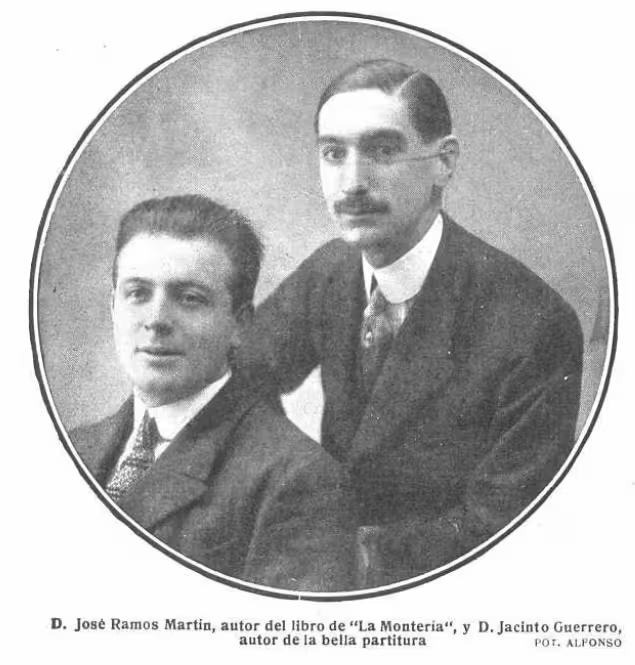
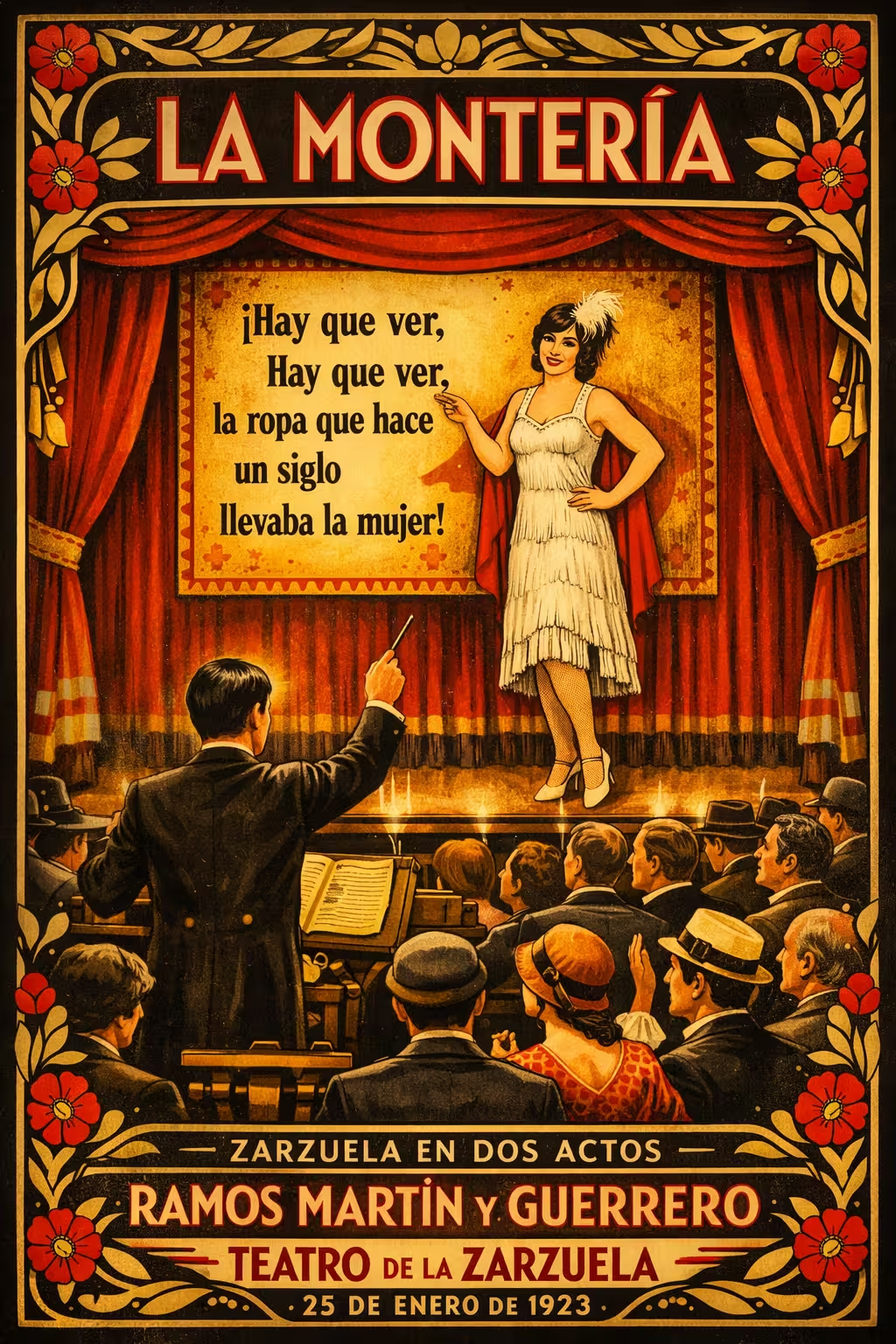
The scene is the Teatro de la Zarzuela, on the night of the 25th of January, 1923, for the Madrid premiere of La montería, a zarzuela with libretto by José Ramos Martín and music by Jacinto Guerrero. The piece had already opened in Zaragoza a couple of months earlier and gone on to considerable success in Barcelona1, so it arrived in the capital with high expectations — expectations it went on to exceed by some distance, since the applause in Madrid was nothing short of rapturous. Several numbers were encored, some more than once, but the one that stole the show was the tango-milonga “Hay que ver mi abuelita la pobre qué cosas usaba!… Hay que ver, hay que ver la ropa que hace un siglo llevaba la mujer” (“You should see what my poor grandmother used to wear!… you should see, you should see the clothes women wore a century ago”), sung by the delightful leading lady Victoria Pinedo. Two reviews from the press of the day give some sense of just how enormous a hit it was:
“Almost every number was repeated, and there was one, sung with great mischief by Miss Pinedo, that was encored amid tremendous ovations no fewer than eight times […] we left the Zarzuela at half past two in the morning, with the curtain still going up for what must have been the hundredth time to receive the audience’s acclaim.”2
“The second act opens with a tango-tempo couplet, delivered with singular charm by the delightful comic lead Victoria Pinedo; this was the much-talked-about number that had gone down so well everywhere, and which yesterday had to be repeated six times as a song and twice more as an interlude, with the whole audience singing along; the ovation for maestro Guerrero, who conducted the orchestra, was rapturous, crowning the extraordinary success of the score.”3
And it was precisely during those repeated encores, with the whole house singing along, that the first karaoke was born — because, on Guerrero’s own instructions, a large placard hung above the curtain during the encores, displaying the lyrics so that everyone in the house could sing along.
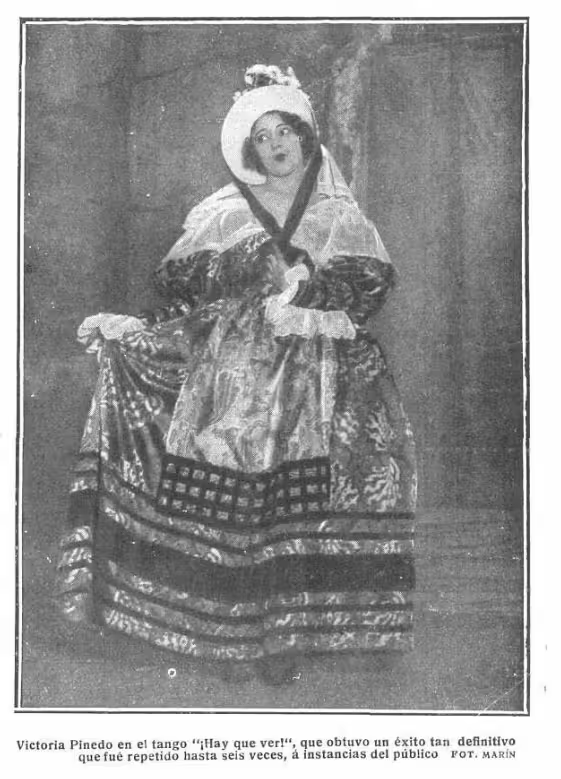
Victoria Pinedo, the leading lady, told a curious anecdote about the Madrid premiere of this piece:
“The curtain that maestro Guerrero had ordered us to make came down: a curtain with a large portrait of myself and the lyrics of ‘Hay que ver’ in bold lettering, so the audience could read them. That was when Jacinto did something no one but he would have dared do, and which, without question, laid the foundations of his enormous popularity: he turned the music stand round, placed himself facing the audience completely —it takes some nerve to do that on opening night!— and began conducting that gigantic choir made up of thousands of voices coming from the stalls, the boxes, the upper galleries, the gods… even the ushers were singing: ‘Hay que ver…, hay que ver… hay que ver… la ropa que hace un siglo usaba la mujer!… Creo yo… creo yo… creo yo… que de una de esas faldas salen lo menos dos…’ It was pandemonium! No one could recall an audience ever having such a riotous time in a theatre. It went on until three in the morning, and people were still singing it in the street afterwards.”4
Which is testimony enough that karaoke was invented by a man from Toledo5, in Madrid, in early 1923, at the Teatro de la Zarzuela, no less.
And to close out this brief chronicle, here is a recording of the famous Hay que ver, performed by Luisa de Córdoba with the Orquesta de Cámara de Madrid, conducted by Enrique Navarro:
Notes
1. At the Teatro Circo, on the 24th of November, 1922.
2. La Libertad, 26 January 1923.
3. El Heraldo de Madrid, 26 January 1923.
4. Biblioteca teatral, by Valentín Azcune.
5. Jacinto Guerrero was born in Ajofrín, a town in the province of Toledo, Spain, in the Sisla district.
A note
A note, dear reader: everything told above —the premiere, the reviews, the placard over the curtain, Victoria Pinedo’s anecdote— is rigorously true and documented in the press of the day. What is a joke, and a deliberate one, is calling it “the invention of karaoke”: nobody at the Teatro de la Zarzuela in 1923 had the faintest idea they were inventing anything, and no serious historian would place this episode anywhere near Kobe, 1971. It was, simply, a beautiful theatrical coincidence that happened to resemble something Japan would genuinely invent fifty years later.