
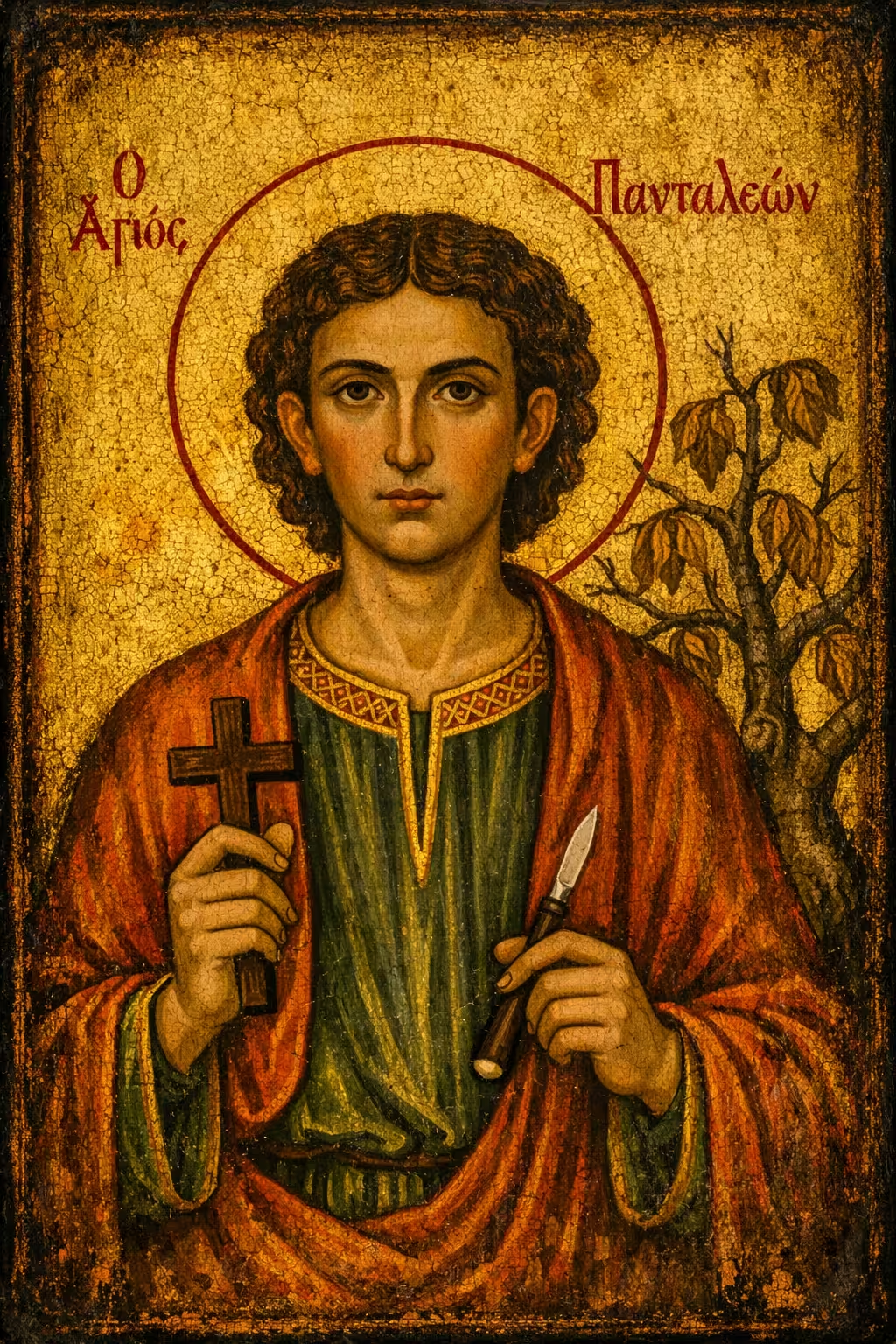
Every 27th of July, at the Real Monasterio de la Encarnación, something happens that has been repeating itself for four centuries now: a substance kept in a small glass ampoule —tradition holds it to be the blood of Saint Pantaleon— turns from solid to liquid. Some call it a miracle. Others, just as convinced, call it superstition dressed up as ritual.
Saint Pantaleon: from court physician to beheaded martyr
According to Christian tradition, Saint Pantaleon was a physician at the imperial court in Nicomedia —modern-day İzmit, in Turkey—, the son of Eustorgius, a pagan, and Eubula, a Christian who died while he was still a child. Having converted to Christianity, he inherited a considerable fortune on his father’s death, which he distributed among the poor, freeing his slaves in the process. He practised medicine without charging the poor, which cost him custom among his fellow physicians; that rivalry ended in denunciation when Diocletian issued his edict against Christians in the year 303. He was arrested, tortured, and finally beheaded on the 27th of July in the year 305.
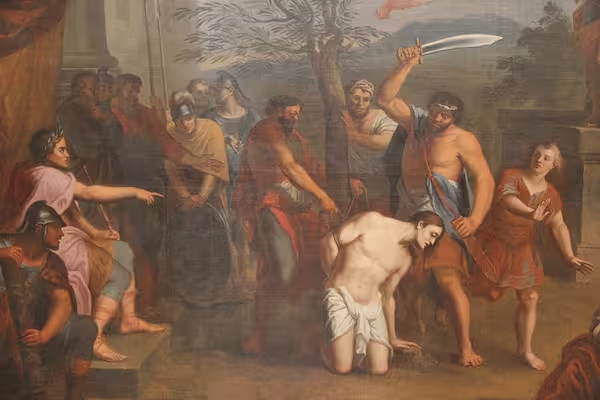
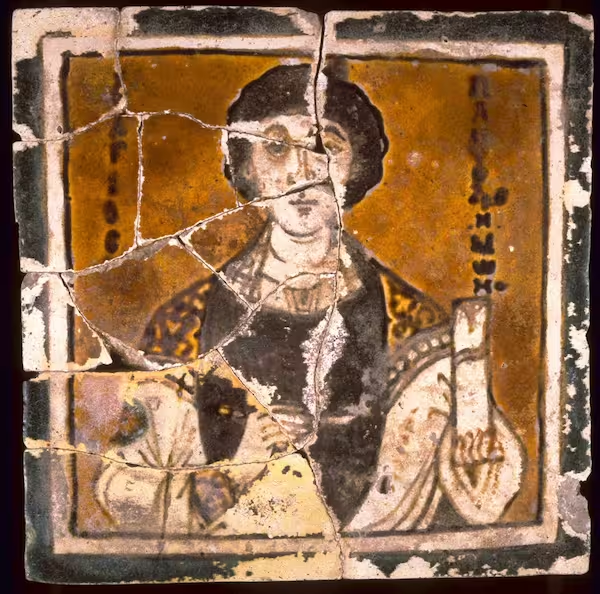
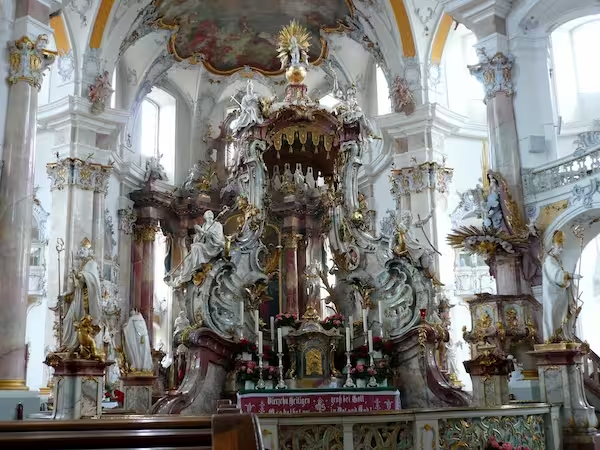
The Church venerates him as one of the Fourteen Holy Helpers, invoked in particular by the sick and by medical professionals. His relics are scattered between Constantinople, the cathedral of Ravello, and the Real Monasterio de la Encarnación in Madrid, where the ampoule of his blood is the object of special veneration every year.
How Saint Pantaleon’s Blood Came to Madrid
The presence of this relic in the Spanish capital is tied to the very origins of the Real Monasterio de la Encarnación, founded by Margaret of Austria, wife of Philip III. In the convent’s early years, one of the nuns who professed there was Doña Aldonza de Zúñiga, daughter of the Counts of Miranda —her father, Juan de Zúñiga, had served as Viceroy of Naples—, who would in time become the convent’s second prioress, after its founder, Mariana de San José. It was she who brought to the reliquary a small crystal ampoule set in gold, containing what was believed to be blood of Saint Pantaleon: a piece which, on the anniversary of the saint’s martyrdom, would leave its coagulated state and turn liquid.
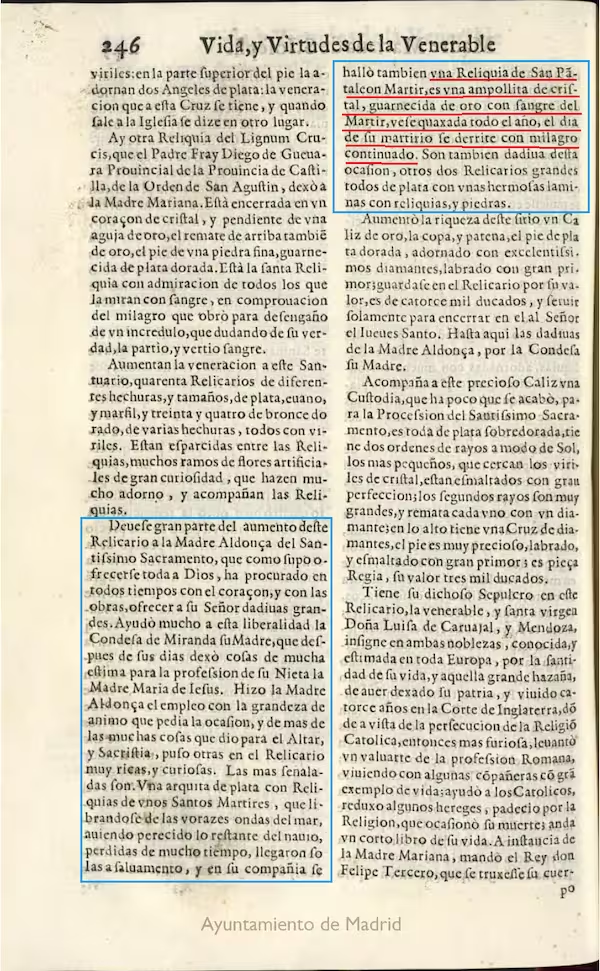

According to the most widely accepted account, the relic had originally come from the cathedral of Ravello and reached Aldonza’s parents through the mediation of Pope Paul V. The ampoule was deposited in the Madrid convent, where it remains in the community’s keeping to this day.
Seven years under notarial watch
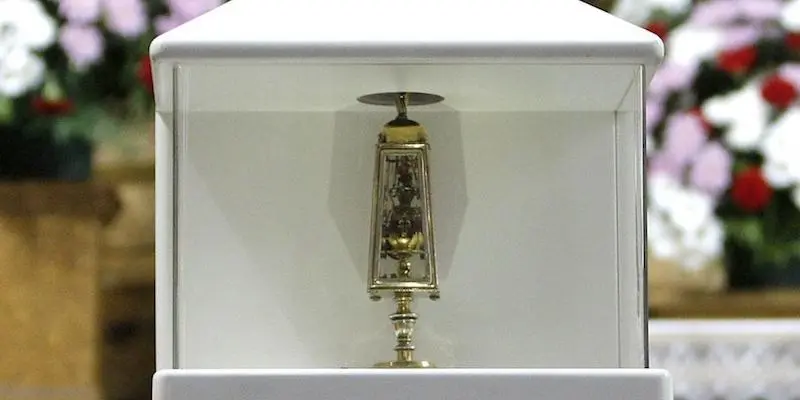
The liquefaction of the blood of Saint Pantaleon at the Real Monasterio de la Encarnación in Madrid —the very phenomenon we have been describing— has been documented for close to four centuries now. As early as 1645, the licenciado Luis Muñoz mentioned it in a work about the convent’s founder, which tells us the prodigy was already the talk of the convent by then. Later, between 1723 and 1730, the Archbishop of Santiago de Compostela, acting as ecclesiastical judge, ordered an inquiry that ran for seven consecutive years: each 27th of July, a panel of thirteen doctors of Medicine and Theology examined the ampoule and signed, before a notary, that the substance turned liquid without any human intervention.
Between faith and science
Every year, on the 27th of July, the ampoule is put on public display, and no small number of the faithful and the merely curious make their way to the convent. Believers hold that Saint Pantaleon grants favours related to health —he was a physician, after all— and it is to him that people still turn for everything from a passing headache to considerably graver complaints.
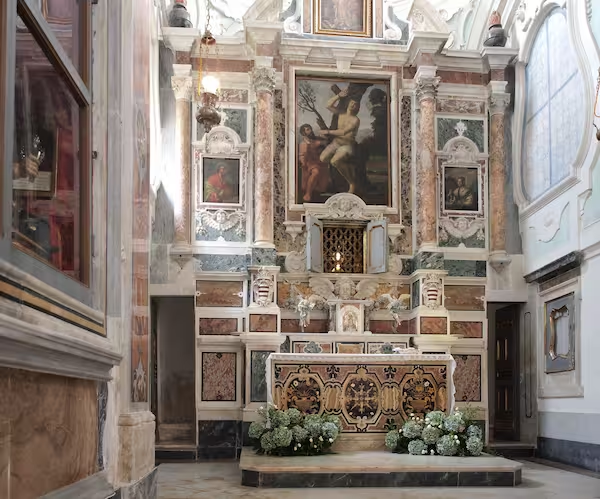
The curious thing is that the phenomenon does not occur in isolation. The larger ampoule —the one at Ravello, from which the Madrid fragment was originally cut— undergoes the very same transformation every 27th of July.
The Church, for its part, has never officially pronounced on the so-called “miracle of Saint Pantaleon,” and there is no record of the relic ever having been subjected to an independent laboratory study. So the hypothesis of a thixotropic substance, one whose viscosity would change with agitation, remains —in the absence of such a study— a reasonable conjecture rather than a verdict.
Science, to be fair, has not been quite so idle with relics of a similar kind. In 1991, researchers Luigi Garlaschelli, Sergio Della Sala, and Franco Ramaccini showed in the journal Nature that a gel with the same thixotropic properties —solid at rest, liquid the moment it is shaken— could be produced with ferric chloride, calcium carbonate, and salt, materials within reach of any workshop as far back as the fourteenth century; the experiment was designed with the blood of Saint Januarius in mind, in Naples, the best-studied case of this kind of phenomenon, and one which, for all that, the Church has likewise never officially recognised as miraculous.
Sources
- Muñoz, Luis. Vida, y virtudes de la venerable M. Mariana de S. Ioseph, fundadora de la Recolección de monjas agustinas, priora del Real Convento de la Encarnación, 1645, p. 246. Biblioteca Digital Memoria de Madrid, Ayuntamiento de Madrid.
- Alfa y Omega. Crónica de la veneración de la sangre de San Pantaleón (in Spanish).
- Real González, Julio. “La licuefacción de la sangre de San Pantaleón en el Monasterio de la Encarnación.” Originally published in Fotomadrid; text supplied directly by the author.
- Archivo Diocesano de Madrid. Información histórica sobre reliquias madrileñas (in Spanish).