In the very heart of Madrid, steps away from the bustle of streets thronged with visitors to the shops and shopping centres that fill this part of the city, the sturdy facades of an old monastery stand out in sharp relief. Built in the Toledan style, with flint rubblework between brick string courses, these walls rise like an impenetrable fortress, seeming to shield from the daily commotion of a contemporary, consumerist and cosmopolitan city the rich world of contemplation, spirituality and sublime art that governs the lives of the Poor Clare nuns who dwell within. This is the Monastery of las Descalzas Reales.
A Royal Monastic Foundation
The main facade of the Monastery-Convent of the Assumption, or of Consolation — better known by its popular name, the Descalzas Reales — opens onto the Plaza de las Descalzas in Madrid.
The monastery was founded by the Infanta Juana of Austria, sister of King Philip II, in 1559, when she converted the medieval ancestral home of the treasurer-general Alonso Gutiérrez, in which she had been born in 1535, into a convent. Both she and her mother, Empress Isabella of Portugal, had lived in that noble mansion while her father and his wife’s husband respectively — Emperor Charles V — was carrying out works of renovation on the uncomfortable and martial Royal Alcázar.
The Infanta always cherished fond memories of her childhood in that house, living in what her brother Philip II would later recall as “the cool rooms overlooking the garden.” Married at seventeen to her cousin the Crown Prince of Portugal, the Infante João Manuel, she gave birth to the future King Sebastian I of Portugal in 1554, eighteen days after the young Portuguese heir — barely sixteen years old — died of diabetes.
Returning to Castile that same year of 1554, she was appointed regent of Castile and León by her father Charles I, who was occupied with travels through Central Europe, while her brother Prince Philip married Queen Mary Tudor of England that same year. When the English queen died in 1558, Philip II returned to Spain, and the following year the Infanta Juana had to relinquish the regency of Castile — a role for which she had shown considerable aptitude.

That same year of 1559, on the feast of the Assumption of Our Lady (15 August), Poor Clare nuns from the Convent of Santa Clara in Gandía, recommended by Saint Francis Borgia, took possession of the new monastery. Founded on the ancestral home that the Infanta had already acquired from the heirs of Alonso Gutiérrez in 1555, the works of conversion were entrusted to the master builder Antonio Sillero. The works on the church, directed by the architect Juan Bautista de Toledo (1515–1567), were not completed until 1564, when the Blessed Sacrament was placed on the high altar in the presence of King Philip II.
The Infanta Juana died in 1573 at El Escorial. Her body was transferred to the monastery she had founded, where today we can admire the magnificent kneeling effigy that represents her, carved by the sculptor Jacome da Trezzo (1515–1589) in the funerary chapel on the epistle side.
A Privilege Unique in Christendom
It is during the liturgical season of Holy Week that an event takes place which might seem somewhat paradoxical: one of the least-known processions in Madrid is dedicated to honouring the Body and Blood of Christ — that is, Corpus Christi — despite the fact that its specific feast day falls several months later.
This is a privilege granted by Pope Paul IV to this Royal Monastery from the time of its foundation in 1559.
What Makes This Holy Week Procession Unique?
The combination of the commemorations of the Holy Burial and of Corpus Christi allows us to witness one of the oldest and most authentic processions in Madrid, with over 450 years of history. The papal privilege permits the Blessed Sacrament to be processed on the afternoon of Good Friday.
For this purpose, the carved figure of the Eucharistic Recumbent Christ by Gaspar Becerra (1520–1568) is used. This is a masterpiece of Mannerist Renaissance sculpture. Carved in polychrome wood, the image depicts the dead Christ with great pathos and anatomical precision. A unique detail is the circular monstrance set into his right side, intended to hold the Consecrated Host, thereby transforming the sculpture into a physical tabernacle.

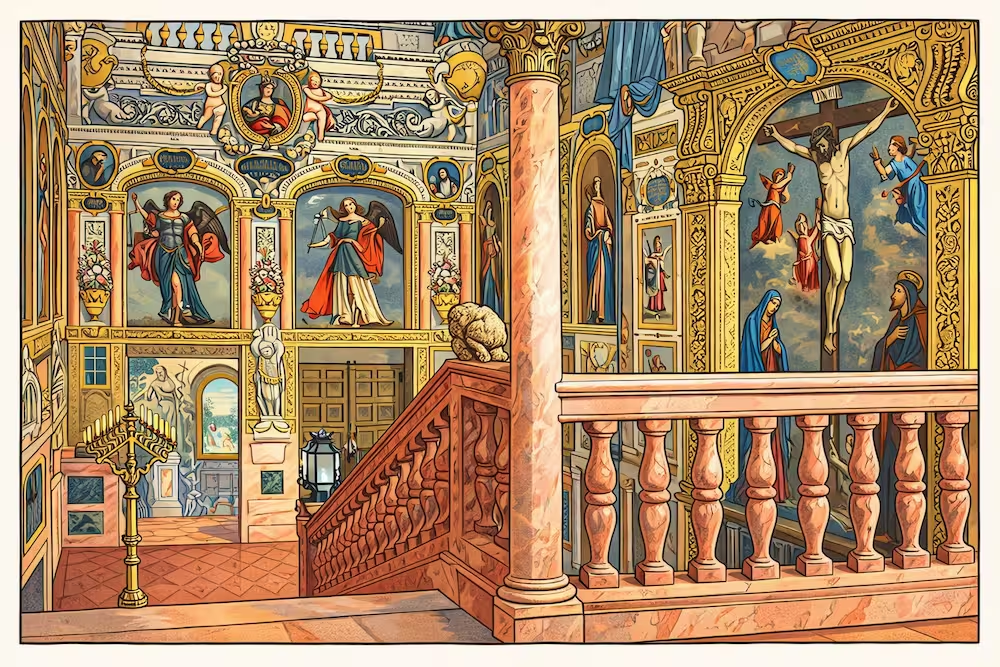
On the afternoon of Good Friday, the walls of the Public Cloister are hung with magnificent Flemish tapestries (seventeenth century), designed by Peter Paul Rubens with scenes from the Eucharist.
The procession sets out from the church, announced by the rasping sound of a large wooden rattle. The figure of the Recumbent Christ moves under a canopy of purple velvet, while the Poor Clare nuns chant music by Tomás Luis de Victoria (1548–1611) from behind the grilles and lattice screens of the enclosure.
USEFUL LINKS
BIBLIOGRAPHY
- CORRAL, José del (1990) Curiosidades de Madrid. El País-Aguilar. Madrid.
- GARCÍA GUTIÉRREZ, Pedro F. and MARTÍNEZ CARBAJO, Agustín F. (2006) Iglesias de Madrid. Ed. La Librería. Madrid.
- GARCÍA SANZ, Ana and SÁNCHEZ HERNÁNDEZ, Mª Leticia (1999) Las Descalzas y la Encarnación. Patrimonio Nacional. Madrid.
- GEA ORTIGAS, Mª Isabel (2010) Madrid Curioso. La Librería. Madrid.
- RÉPIDE, Pedro de (1981) Las calles de Madrid. Afrodisio Aguado. Madrid.